
Type Of Filter Press
Filter presses are essential equipment used in various industries to separate solids from liquids. Specially for wastewater treatment and food industry.
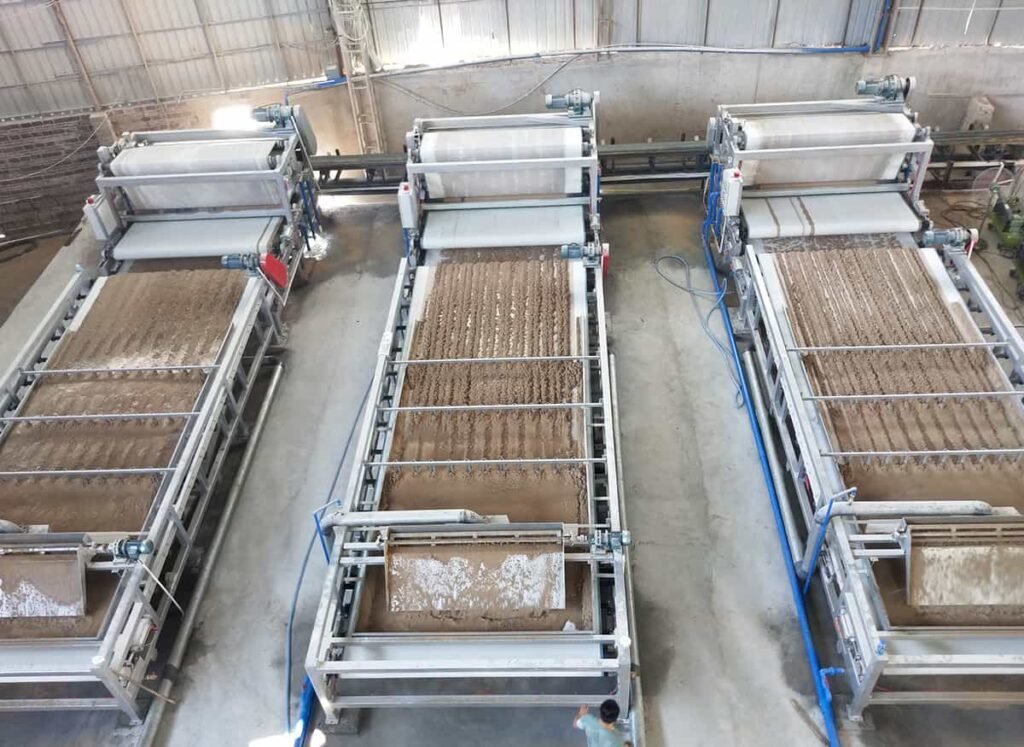
Belt Filter Press
Belt press is a continuous filtration system in which liquid is squeezed out of the slurry using a number of endless belts. Slurry is introduced onto the belt and is squeezed along its length by rollers, forcing the moisture out of the solids. This kind of filter is very common for wastewater treatment and industries, such as paper manufacturing, due to the need for a huge volume of slurry being dewatered quickly and efficiently. They are less suited to applications requiring very high-pressure filtration or where the solids content of the slurry is particularly high.
Plate and Frame Filter Press
The plate and frame filter press is one of the oldest and most general designs. It basically consists of a number of alternate solid plates and hollow frames. Slurry is pumped into the frame where the liquid passes through the filter cloth while leaving the solid material on the cloth. These are known for their ability to handle viscous slurries and generally simple design. However, they require much labor for the maintenance and removal of cake from the filter; hence, they are not at all suitable for large-scale automatic operations.
Recessed Plate Filter Press
This type of filter press contains recessed chamber plates without separate frames. Slurry is pumped into the chambers, where filtration occurs just like in the plate and frame press. The recess helps in better cake formation and higher pressure filtration. They are used everywhere in mining, chemical processing, and wastewater treatment, owing to their efficiency and fairly low maintenance needs.
Membrane Filter Press
The membrane filter press features an advanced design by adding flexible membranes that inflate within the filter chambers. After preliminary filtration, the membranes inflate and press extra pressure on the cake to reduce its moisture content even further. This is quite effective in applications where the final product has to possess very low moisture content, such as pharmaceuticals or food products. This is a costlier option; with this improved dewatering efficiency, though, the processes that were costly for drying can save significantly.
Automatic Filter Press
Fully automatic filter presses are designed for continuous operation, minimizing interaction with humans. These machines are equipped with plate shifting, cloth washing, and cake discharge capabilities. This is also useful in industrial fields involving large-scale applications requiring high throughput and consistent operation, such as municipal and industrial wastewater treatment. Also, while the investment cost of an automatic one is higher, these conditions are usually offset by reductions in manpower and efficiency.
Vacuum filter press
On the other hand, vacuum filter presses work by using a vacuum that sucks through the liquid in the filter medium, leaving the solids behind. These are normally utilized in materials with distribution that has fine particle-sized feed where gravity or pressure alone is not good enough to attain the desired separation. These generally find applications in industries dealing with ceramics and metallurgy, and sometimes in the food industry, when gentle product handling is compulsory for maintaining quality.