
Cassava residue dehydrator
Cassava residue dehydration is a crucial step in cassava starch processing, bio-feed production, and environmental treatment. Belt presses, with their high efficiency and continuous dehydration capabilities, have become the core equipment for reducing the volume of cassava residue.
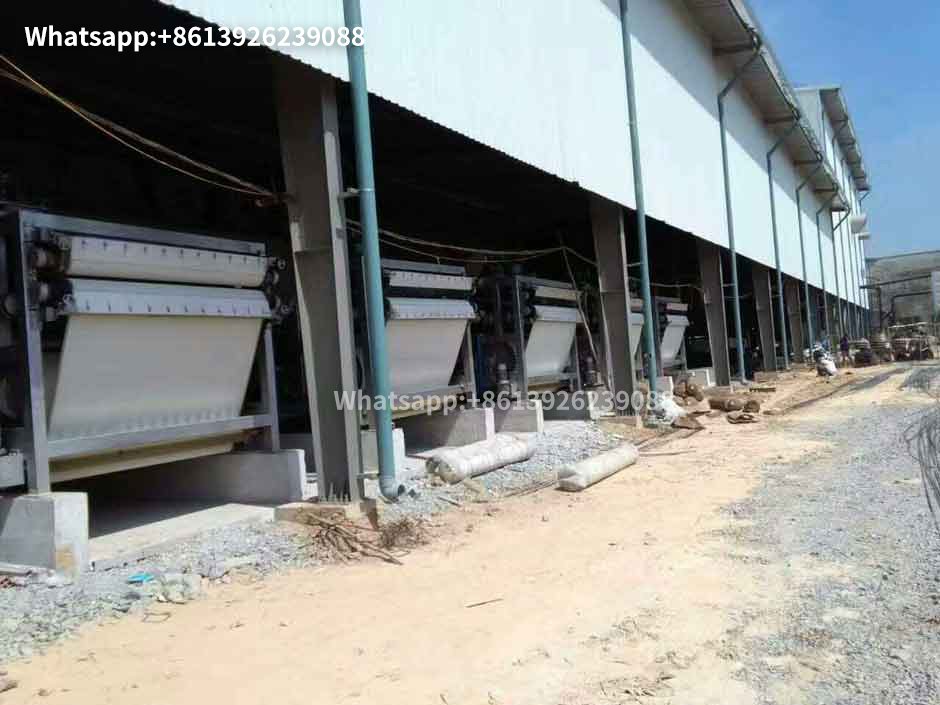
Principle of cassava residue dehydration
The dehydration of cassava residue by belt presses is essentially a synergistic effect of “mechanical extrusion + filter cloth filtration.” It gradually separates free water and some bound water from the cassava residue through gradient pressure, with no chemical additives throughout the process. This aligns with environmental protection and agricultural resource utilization needs, and is essentially divided into four stages:
1. Pre-dehydration stage (gravity filtration)
Cassava residue (initial moisture content 85%-95%) is evenly spread on the Meibang customized filter cloth through the feeding device. With the help of gravity, the free water on the surface of the cassava residue quickly penetrates the filter cloth, laying the foundation for subsequent extrusion and dehydration .
2. Wedge extrusion stage (gradual pressure application)
The pre-dehydrated cassava residue enters the wedge-shaped zone along with the filter cloth, and the upper and lower filter cloths gradually come together to form a gradually compressed space.
Gradually squeeze out the water in the gaps inside the cassava residue
3. High-pressure pressing stage (core dehydration)
After entering the high-pressure pressing zone, the cassava residue is subjected to high-intensity extrusion, forcibly separating the bound water between the fibers.
4. Unloading and filter cloth cleaning stage
After dehydration, the cassava residue is transported to the unloading area along with the filter cloth and is automatically scraped off by a scraper device without manual intervention. At the same time, the Meibang equipment is equipped with a high-pressure spray system to wash the filter cloth in real time and remove residual cassava residue fibers.
Core applications: Environmental protection and resource recycling covering multiple fields.
The dehydration process of belt presses not only solves the environmental problem of cassava residue disposal but also achieves resource reuse, and is widely used in the following scenarios:
1. Cassava starch processing industry
The large amount of cassava residue produced during starch production can be directly used as feed raw material (high in protein and fiber) after dehydration, or further dried and used for biomass fuel and organic fertilizer production.
2. Bioenergy sector
Dehydrated cassava residue (with a moisture content of about 40%) can be directly used for biomass power generation and biomass pellet production. Compared with undehydrated raw materials, it increases combustion efficiency by 30% and reduces transportation costs by 50%, making it an important raw material in the field of clean energy.
3. Environmental protection treatment scenarios
Cassava residue waste from large-scale cassava planting bases and starch processing plants can easily cause soil and water pollution if directly dumped. After being dehydrated by a belt press, the volume of the waste residue is reduced by more than 70%, making it easier to transport and centrally dispose of.
4. Agricultural Circular Economy
Dehydrated cassava residue, when mixed and fermented with livestock and poultry manure and straw, can be made into high-quality organic fertilizer, which can be returned to farmland to improve soil fertility, forming a circular industrial chain of “cassava planting → starch processing → waste residue fertilizer production → return to planting”, which is in line with the concept of green development in modern agriculture.
Advantages of Meibang Belt Press
High efficiency and energy saving: In continuous operation mode, it has a high processing capacity and energy consumption is 30%-50% lower than that of traditional dewatering machines.
Environmentally friendly and safe: No chemical agents are added throughout the process, avoiding secondary pollution and meeting green production standards.
High degree of automation: PLC control system reduces manual intervention, is easy to operate, and reduces labor intensity.
Wide applicability: It is not only suitable for cassava residue, but also for processing high-moisture materials such as plant residue, pulp , coconut coir , and fruit and vegetable residue, making it highly versatile.